|
|
 |
 'If I Had A Hammer,' 'Midnight Special,' 'The Sloop John B,' 'Goodnight, Irene,' 'This Land Is Your Land, 'Tzena Tzena,' 'Wimoweh,' 'House Of The Rising Sun,' 'Michael Row The Boat Ashore.' Songs such as these have become part of our collective consciousness. But few recall that these songs were written or first popularized by The Weavers. The seminal link between an obscure past and contemporary culture, The Weavers introduced a stream of authenticity into the current of American popular music that endures to this day. 'If I Had A Hammer,' 'Midnight Special,' 'The Sloop John B,' 'Goodnight, Irene,' 'This Land Is Your Land, 'Tzena Tzena,' 'Wimoweh,' 'House Of The Rising Sun,' 'Michael Row The Boat Ashore.' Songs such as these have become part of our collective consciousness. But few recall that these songs were written or first popularized by The Weavers. The seminal link between an obscure past and contemporary culture, The Weavers introduced a stream of authenticity into the current of American popular music that endures to this day.
Much of the modern American folk revival rests on the shoulders of an earlier folk revival in the 1930s. Back then, the ravages of the Great Depression had many wondering whether the capitalist system would survive and compelled many to look for viable alternatives. In the process, the era witnessed a burgeoning union movement, an increase in radical politics, and a simultaneous reawakening of interest in American folk music.
|
 |
|
During this period, both Pete Seeger and Lee Hays cut their musical teeth. Having grown up in the puritanical northeast as the son of a concert violinist and a musicologist, Pete dropped out of Harvard to work with Alan Lomax cataloguing folk music for the Library of Congress. There he vowed not to dig up old songs from one graveyard just to bury them in another. Lomax introduced him to Woody Guthrie and the two roamed the country together learning, singing and writing songs for unions and other groups.
Hays, the son of an Arkansas preacher, got most of his education working as a page in the Cleveland Public Library and later at Arkansas' Commonwealth College. There, working with the radical preacher Claude Williams to organize sharecroppers, Hays learned the value of a familiar melody as an organizing tool. When Pete and Lee met up in New York in 1940, the creative sparks began to fly, and American music would never be the same.
The two headed up The Almanac Singers in 1941 and recorded the much acclaimed 'Talking Union' album, touring the country in support of the Congress of Industrial Workers (CIO) and other progressive groups. But their anti-war album Songs For John Doe got them into trouble. When Hitler's armies attacked Russia, they quickly amended their repertoire to include songs such as 'Round and Round Hitler's Grave.' But it was too late. The FBI was already investigating them for the earlier recording and would dog them for the rest of their careers. When assessing their political stance, it's important to remember the times. Whereas today civil rights and the right to join a union, as well as respect for diversity, are written into law or official government policy, back then in the minds of many these beliefs seemed downright subversive.
|
|
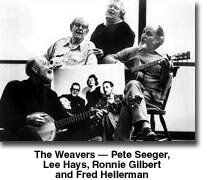 Returning to New York following service during World War Two, Pete and Lee teamed up with the brilliant guitarist Fred Hellerman and the exceptional alto Ronnie Gilbert to create The Weavers in 1948. Drawing from many varied sources including international music and traditional ballads, work songs and hymns, lullabies and the songs of Woody Guthrie and Huddie Ledbetter (Leadbelly), The Weavers presented an eclectic array of folk music with a freshness and exuberance that had never before been heard. Their musical verve and their knack for breathing life into a song soon caught the attention of bandleader Gordon Jenkins at Decca Records. A string of hits followed including 'On Top Of Old Smoky,' 'Wimoweh,' 'Midnight Special,' 'Tzena, Tzena,' Woody Guthrie's 'So Long, It's Been Good To Know Ya' and of course, Leadbelly's 'Goodnight Irene.' Blacklisted and forced from the stage for their political beliefs during the height of their popularity, The Weavers reunited and persevered long enough to inspire the 'folk boom' of the '50s and '60s. They then passed the microphone to the likes of The Tarriers and The Kingston Trio, Peter, Paul & Mary, Joan Baez, Don McLean and Bob Dylan, all of whom credit The Weavers among their earliest musical influences. Returning to New York following service during World War Two, Pete and Lee teamed up with the brilliant guitarist Fred Hellerman and the exceptional alto Ronnie Gilbert to create The Weavers in 1948. Drawing from many varied sources including international music and traditional ballads, work songs and hymns, lullabies and the songs of Woody Guthrie and Huddie Ledbetter (Leadbelly), The Weavers presented an eclectic array of folk music with a freshness and exuberance that had never before been heard. Their musical verve and their knack for breathing life into a song soon caught the attention of bandleader Gordon Jenkins at Decca Records. A string of hits followed including 'On Top Of Old Smoky,' 'Wimoweh,' 'Midnight Special,' 'Tzena, Tzena,' Woody Guthrie's 'So Long, It's Been Good To Know Ya' and of course, Leadbelly's 'Goodnight Irene.' Blacklisted and forced from the stage for their political beliefs during the height of their popularity, The Weavers reunited and persevered long enough to inspire the 'folk boom' of the '50s and '60s. They then passed the microphone to the likes of The Tarriers and The Kingston Trio, Peter, Paul & Mary, Joan Baez, Don McLean and Bob Dylan, all of whom credit The Weavers among their earliest musical influences.
|
|
|
|
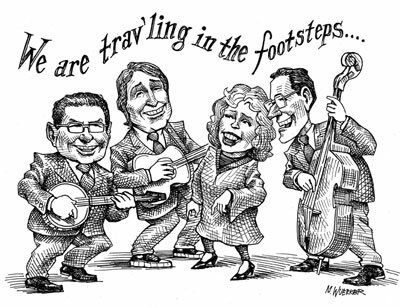
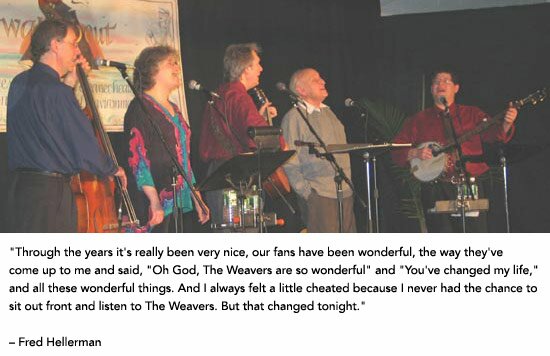
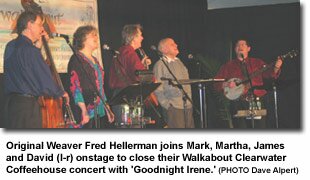
With faithful adherence to their original arrangements, we seek to recall the spirit of The Weavers, providing an echo of their music and some insight into their story, one that resonates ever so strongly in these troubled times when an American's right – and indeed, responsibility – to dissent is once again being challenged. It is therefore a distinct privilege for us, and it is with profound pleasure that we present the timeless music and the timely message of ‘Work o' The Weavers'.
— David, James, Mark and Martha
|
|
|
"If I'm an expert in one thing, it's in the Weavers' music. When I heard (Work o' the Weavers) I got blown away. Great! (They) have it exactly right!"
– Alan Chartock, WAMC-FM, Albany NY more reviews
|
|
|